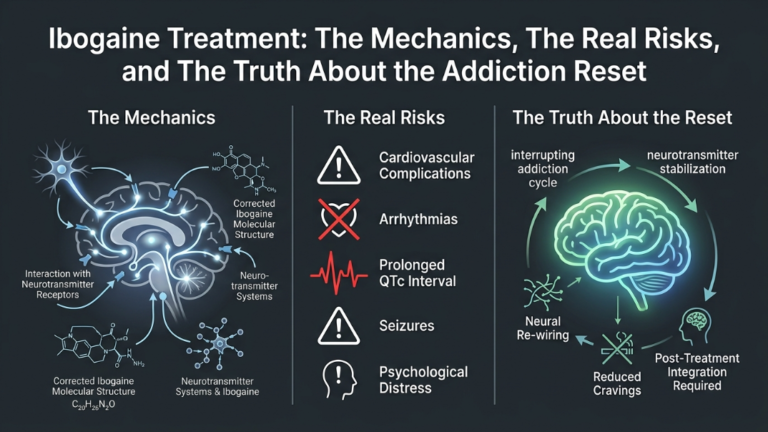
Ibogaine Treatment: The Mechanics, The Real Risks, and The Truth About the Addiction Reset
Traditional recovery programs often feel like a revolving door. You walk into a detox center,


Opioid withdrawal is often described by the people living through it as the closest thing to hell they’ve experienced while still breathing. It’s a big part of why opioid use disorder is so difficult to escape — the fear of withdrawal alone keeps people using long after they’ve decided they want to stop. This is the exact problem that has pulled growing scientific and clinical attention toward ibogaine for opioid addiction: an African-plant-derived alkaloid reported, in study after study, to interrupt physical withdrawal in a single session rather than the days-to-weeks taper required by conventional detox. This article walks through what’s actually happening in the brain, what the research does and doesn’t support, what responsible treatment requires, and where US readers legally stand today.
Opioid dependence rewires the brain’s reward and stress systems over time. With repeated use, the brain down-regulates its own natural opioid signaling and comes to depend on the drug just to feel normal. When the drug is removed, the result is the well-known withdrawal syndrome — muscle pain, nausea, insomnia, anxiety, and an overwhelming craving that conventional tapering protocols are built to manage gradually, often over days or weeks. For many people, that withdrawal window is where relapse happens, not because they lack willpower, but because the physiological pull is so severe.
This is the specific problem ibogaine has drawn scientific interest for addressing: not just easing cravings over time, but potentially compressing and interrupting the acute withdrawal process itself. Iboga through ibogaine for opioid addiction has helped a lot of people both formally through clinics and informal (off the shelf — Not Advised unless you have consulted an expert )
Ibogaine’s pharmacology is unusually complex compared to most addiction treatments, which is part of why researchers have struggled to pin down a single, complete mechanism. Rather than acting on one receptor system, ibogaine and its primary metabolite, noribogaine, interact with several simultaneously:
Researchers have started referring to this combined effect as a neurobiological “reset” framework — not a literal rebooting of the brain, but a description of how ibogaine appears to reconfigure addiction-related circuitry while opening a temporary window of heightened neuroplasticity that may make lasting behavioral change more achievable. It’s an evocative term, but it’s worth treating it as a working hypothesis rather than settled science — the full mechanism is still being mapped.
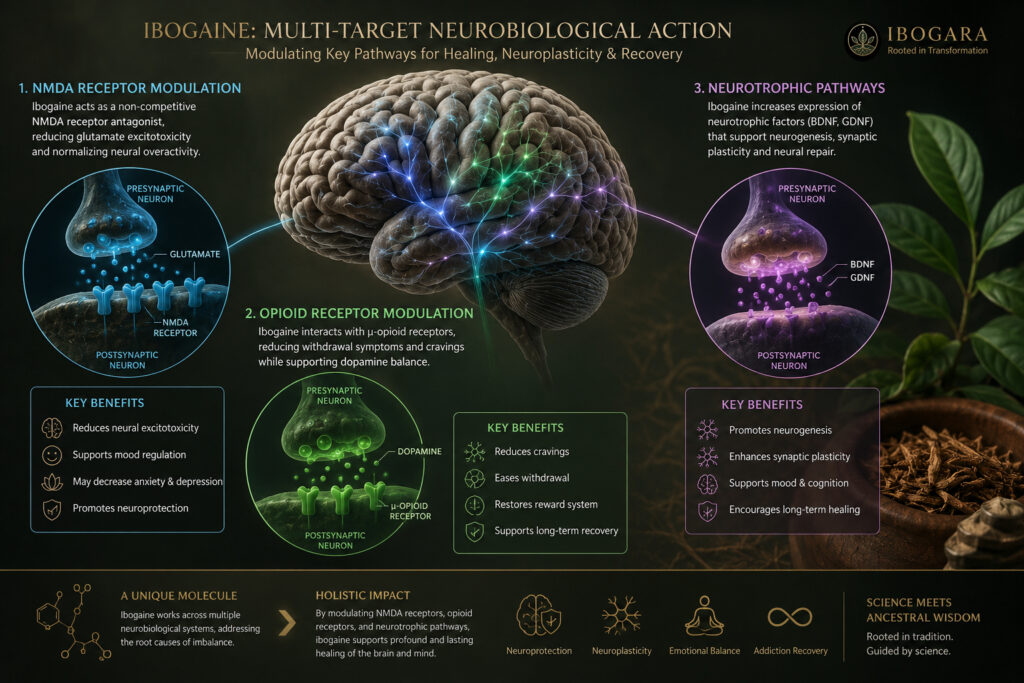
image: brain/receptor diagram illustrating NMDA, opioid receptor, and neurotrophic pathways
It’s important to be precise here, because this is an area where hope and hype blur together easily. As of 2026, only two randomized controlled trials have been conducted on ibogaine or noribogaine specifically for substance use disorders. Most of what’s known comes from open-label observational studies, case series, and preclinical animal research — real evidence, but a lower tier of certainty than the large randomized trials used to approve most FDA medications.
What the existing research does show:
What the research does not yet show:
None of this means ibogaine doesn’t work. It means the evidence base is real but still developing, and anyone considering treatment deserves an honest picture of where the science currently stands rather than a sales pitch.
Physical withdrawal interruption is only half of what people report from ibogaine treatment. The experience itself is intensely psychoactive — often described as a waking, dream-like state involving vivid recall of past memories, relationships, and the events that shaped a person’s relationship with substances. This has led some researchers and clinicians to frame ibogaine less as a detox tool and more as a catalyst: it removes the physiological barrier of withdrawal while simultaneously surfacing psychological material that can be processed, often for the first time in years without the fog of active use or acute withdrawal.
This is also why credible ibogaine programs pair the treatment session with integration support — structured time afterward to process what surfaced, translate insight into behavior change, and connect the experience to an ongoing recovery plan. Ibogaine interrupting withdrawal is a starting point, not a finish line; the people who tend to sustain recovery are the ones who treat it that way.
Every reputable program differs in its specifics, but published case reports and clinical guidelines describe a broadly consistent shape to the experience: an acute phase in the hours immediately following administration involving intense visionary or introspective effects, followed by a longer “grey” or reflective phase over the following day as the acute effects subside, during which patients frequently report reviewing significant life events and relationship patterns. Physical withdrawal symptoms are commonly reported as substantially reduced or absent within the first 24 to 72 hours — a dramatically different timeline than the days-to-weeks taper of conventional opioid detox. Recovery from the experience itself, along with structured integration conversations, typically continues for several days after the physical effects resolve.
If you’re researching individual accounts, look for peer-reviewed case series and published patient-reported outcome studies rather than relying solely on anecdotes from a provider’s own marketing materials — the two carry very different evidentiary weight, even when the stories themselves are genuine.
| Methadone / Buprenorphine (MAT) | Ibogaine | |
|---|---|---|
| Mechanism | Full or partial opioid agonist; maintains receptor activation | Non-agonist multi-receptor action (NMDA, opioid, neurotrophic pathways) |
| Treatment model | Ongoing daily maintenance, often long-term | Typically a single supervised session |
| Withdrawal timeline | Managed gradually via tapering, days to weeks | Reported substantial reduction within 24–72 hours |
| US legal status | FDA-approved, widely available | Schedule I; not legally available outside authorized trials |
| Evidence base | Decades of large-scale RCTs | Preliminary; two RCTs to date, plus observational and preclinical data |
| Primary risk | Diversion, continued dependence, overdose if misused | Cardiac arrhythmia, particularly without proper screening |
This isn’t a case of one approach being categorically “better” — they’re different tools with different risk profiles, timelines, and evidence bases, and the right fit depends heavily on an individual’s medical history and circumstances. Some patients also use ibogaine treatment alongside a longer-term MAT taper rather than as a standalone replacement; that decision should always be made with a physician, not a website.
This is the section that matters most, and it deserves to be read in full before anything else in this article.
Ibogaine carries a well-documented cardiac risk. It can prolong the heart’s QT interval and, in a minority of cases, trigger a dangerous arrhythmia called torsades de pointes. Fatalities have occurred, disproportionately in unsupervised settings without proper screening — some estimates put the risk at roughly 1 in 300 treatments in uncontrolled conditions, which is precisely why medical protocol is not optional.
Responsible harm reduction in this context does not mean instructions for self-administration — it means insisting on a treatment environment that includes:
The single most dangerous version of ibogaine use is the unsupervised, self-directed version — sourced online, taken without screening, without monitoring, and without a plan for what happens if something goes wrong. If you take one thing from this article, let it be this: the setting and medical protocol matter as much as the substance itself.
If you or someone you know is in a mental health crisis or experiencing thoughts of self-harm, please reach out to the 988 Suicide & Crisis Lifeline (call or text 988 in the US) — support is available right now.
Ibogaine is a Schedule I controlled substance under US federal law, meaning it cannot be legally possessed, prescribed, or administered anywhere in the United States outside an FDA-authorized clinical trial. That applies in all 50 states, though a growing number of states — including Texas, Mississippi, Arizona, and Kentucky — have passed legislation funding ibogaine research aimed at eventual FDA approval, and a 2026 federal executive order has begun building a narrow “Right to Try” pathway for some patients. None of this currently amounts to legal treatment access inside the US.
It remains lawful for Americans to travel abroad and receive ibogaine treatment in a country where it is legal or unregulated, such as Mexico, which is why medical travel is the primary pathway US patients use today. For a full breakdown of state legislation, the federal executive order, and country-by-country legal status, see our companion guide, Ibogaine Legality in the US: What You Need to Know.
Because ibogaine treatment sits at the intersection of real medical promise and a largely unregulated international market, vetting a provider matters as much as understanding the science. Before committing to any program:
Organizations focused on education rather than sales — such as Ibogara, which tracks the research, legal landscape, and cultural context around ibogaine — can be a useful starting point for orienting yourself before you ever contact a specific clinic.
Does ibogaine cure opioid addiction in one treatment? No single treatment “cures” addiction. Ibogaine appears to interrupt physical withdrawal and craving intensity, and can catalyze psychological insight, but sustained recovery still depends on integration, ongoing support, and addressing the underlying drivers of use.
Is ibogaine legal for treating opioid addiction in the US? No. It’s a Schedule I controlled substance federally, with no general medical exception in any state as of 2026.
How is ibogaine different from methadone or buprenorphine? Methadone and buprenorphine are opioid agonists or partial agonists taken on an ongoing basis to manage dependence. Ibogaine is not a classic opioid agonist and is typically administered as a single, medically supervised session intended to interrupt withdrawal and dependence rather than maintain it.
What’s the biggest risk with ibogaine treatment? Cardiac complications, specifically QT interval prolongation that can lead to dangerous arrhythmias. This risk is why medical screening and continuous monitoring are non-negotiable, not optional extras.
Where can Americans legally access ibogaine treatment? Through travel to a country where it’s legal or unregulated, such as Mexico, since receiving legal medical treatment abroad does not violate US law. Bringing ibogaine back into the US is illegal.
This article is for educational purposes and is not medical or legal advice. Ibogaine carries serious, documented health risks, including the potential for fatal cardiac complications. Consult a qualified physician before considering treatment, and a qualified attorney for legal questions specific to your situation. If you are struggling with opioid use, the SAMHSA National Helpline (1-800-662-4357) offers free, confidential support and treatment referrals 24/7.

Traditional recovery programs often feel like a revolving door. You walk into a detox center,
If you live in America and find yourself trapped in the cycle of severe substance

Most conventional addiction treatments feel like dragging a heavy sled through deep mud. You decide