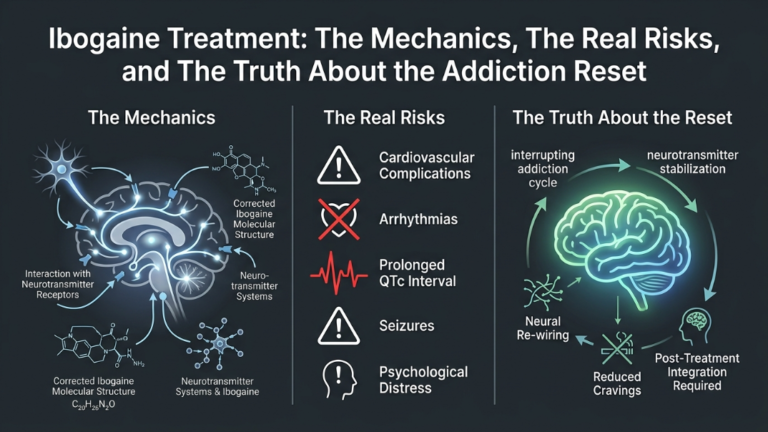
Ibogaine Treatment: The Mechanics, The Real Risks, and The Truth About the Addiction Reset
Traditional recovery programs often feel like a revolving door. You walk into a detox center,

If you live in America and find yourself trapped in the cycle of severe substance dependency, you quickly learn that the traditional treatment system has some massive gaps. You go through the standard loop: detox, thirty days in a residential facility, a handful of support groups, and a mountain of medical debt. For millions of people, this cycle repeats five, ten, or fifteen times without providing lasting relief.
When you start looking for an alternative that actually treats the root of the problem, you inevitably encounter the term ibogaine therapy usa.
The stories you read online suggest a massive contradiction. On one side, you hear about a revolutionary botanical compound that completely resets the brain, stops withdrawal in its tracks, and frees people from chronic addiction in a matter of days. On the other side, you find out that you cannot simply walk down to your local clinic or pharmacy to get it.
The reality of accessing this treatment as an American is shifting rapidly. We are seeing an unprecedented surge in state-level funding, university-led clinical trials, and federal research mandates. Yet, the day-to-day choices for an individual looking for immediate help remain complex, hidden, and sometimes dangerous.
Here is the raw look at the current infrastructure, the state of domestic research, and what your options actually look like right now.
When you type ibogaine therapy usa into a search engine, you are met with a wall of confusing information. You see advertisements for luxury oceanfront retreats mixed with dense academic papers from medical journals. It is easy to get the impression that a legitimate domestic industry exists just beneath the surface.
Let’s clear up the confusion immediately.
Right now, you cannot open a public, commercial clinic inside the United States to offer ibogaine therapy for addiction. The regulatory barriers keep the compound under lock and key. It sits in the tightest restrictive category, meaning regular doctors cannot write a prescription for it, and insurance companies will not cover a single dime of the cost.
This structural barrier creates a stark divide. On one side, you have the formal medical establishment slowly moving through the multi-year process of clinical validation. On the other side, you have thousands of desperate American citizens boarding planes every single month to access treatment centers operating in international territories where the regulations are different.The domestic landscape is entirely defined by this tension. The demand for a real solution to the opioid crisis is pushing the system to its breaking point, forcing lawmakers and scientists to reconsider a substance they ignored for half a century.
The biggest disruption to the status of ibogaine therapy in the usa did not come from an underground advocate or a progressive coastal city. It came from the state of Texas.
In a move that surprised the entire medical community, Texas lawmakers approved a massive fifty-million-dollar taxpayer investment specifically dedicated to psychedelic research. The state created a dedicated consortium uniting major public universities and hospitals to study how this specific compound treats severe opioid use disorder and co-occurring brain trauma.
Initially, the state tried to find private pharmaceutical developers to take the funds and drive the project forward. The bureaucratic requirements were incredibly high. Private companies had to match the fifty million dollars out of their own pockets and establish an explicit corporate footprint inside the state.
When those private partnerships stalled, Texas chose a completely unprecedented path. The state government decided to bypass the corporate pharmaceutical machine entirely.
The state gave the green light to institutions like UTHealth Houston and the University of Texas Medical Branch at Galveston to launch their own state-funded, independent research programs. They are currently building the clinical trial frameworks to test the safety, efficacy, and dosing protocols of iboga alkaloids directly on human subjects.
This is not a casual pilot program. This is a massive, multi-year, state-directed push to gather the exact type of data that the federal government requires for medical approval. Texas is effectively treating addiction as a public emergency, using its own resources to build the scientific foundation that the rest of the country has refused to fund.
While Texas runs its state-wide consortium, individual academic institutions across the country are launching their own targeted studies. These projects are quietly transforming how researchers view ibogaine therapy.
Consider the work happening at the University of California, Irvine. Researchers there have opened clinical trials aimed specifically at mapping the neural dynamics of ibogaine in people suffering from moderate-to-severe opioid use disorder.

Image: Richard E. Harris, PhD, a professor of anesthesiology and perioperative care in the UC Irvine School of Medicine and head of the Pain in the Brain Lab.
These studies do not rely on anecdotal stories or personal testimonials. They put participants into highly controlled hospital environments, hook them up to advanced brain-imaging equipment, and monitor their biology in real time.
They are looking at several critical factors:
This type of research strips away the counter-culture stigma that has plagued the plant for decades. By treating the compound with the exact same scientific rigor used for new cancer drugs or heart medications, these universities are creating a body of literature that cannot be dismissed by traditional physicians.
The sudden momentum behind ibogaine therapy usa is not just a collection of disconnected state projects. It has reached the highest levels of the federal government, driven largely by an unexpected group of advocates: military veterans.
Special operations veterans returning from combat zones have faced a dual crisis of severe post-traumatic stress disorder and traumatic brain injury. Many of them fell into deep substance abuse as a result of their service. After finding no relief in standard military medical channels, groups of veterans began traveling internationally to undergo iboga treatments.
The results they reported were so profound that they caught the attention of Stanford University researchers, who published studies showing massive, immediate reductions in PTSD, depression, and anxiety symptoms among veterans who took the compound.
| Patient Group | Standard Veterans Affairs Care | Iboga-Assisted Protocols |
|---|---|---|
| Clinical Focus | Symptom management through medication and psychotherapy | Trauma-focused intervention incorporating ibogaine-assisted treatment |
| Reported Symptom Improvement | Often gradual and variable, depending on treatment and individual response | Large symptom reductions have been reported in some observational studies; results have not yet been confirmed in large randomized clinical trials |
| Treatment Duration | Ongoing treatment that may continue for months or years | Typically one or two monitored dosing sessions, with follow-up integration and supportive care |
This veteran-led advocacy forced a significant federal response. A presidential executive order explicitly directed federal agencies to accelerate the review and facilitate the research of psychedelic drugs to treat serious mental health illnesses and substance dependence.
Following that order, lawmakers in Congress introduced bipartisan legislation to enshrine these research pathways into permanent law, aiming to protect veterans’ access to these cutting-edge options. The federal government is finally acknowledging that the current addiction treatment model is failing its most vulnerable citizens, and they are opening the doors for alternative options to prove their worth.
Because the official university trials are highly selective and take months to accept patients, everyday Americans looking for immediate ibogaine therapy for addiction face a difficult, real-world choice. They operate in a split reality.
This split reality forces patients down one of two distinct paths.
![ibogaine therapy usa infographics
/---> Path A: Underground Domestic Sessions (High Risk)
[American Seeking Immediate Help]
\---> Path B: International Destination Medical Care (Safer)](https://ibogara.com/wp-content/uploads/2026/07/image-10-1024x576.png)
A completely unregulated, underground network operates inside the United States. Providers set up temporary sessions in private homes, rented Airbnbs, or remote cabins. They source their materials through international channels and administer the drug completely outside the medical system.
This path is incredibly dangerous. An ibogaine flood dose strains the human cardiovascular system by slowing down the heart and altering electrical intervals. Doing this in a suburban house without advanced cardiac monitoring equipment, emergency medications, or a licensed medical doctor on site is a massive gamble with your life. If your heart slips into an arrhythmia in an underground session, the people running the house cannot save you.
The second path involves traveling to countries where the compound sits in a different regulatory category. Nations like Mexico and Costa Rica have become the primary destination hubs for American citizens.
In these countries, providers can establish fully transparent, open operations. This allows the best clinics to build advanced, hospital-grade facilities right across the border, giving American patients a way to access the medicine without sacrificing modern medical safety standards.
Since regular American medical boards do not oversee international clinics, the responsibility of vetting a facility falls entirely on the patient or their family. The quality of care varies wildly once you leave the United States.
You will find some operations that look like high-end wellness spas, focused heavily on yoga, organic food, and spiritual meditation. While those elements are great for recovery, they are completely useless if you experience a cardiac emergency during your session.
A safe, valid medical model must prioritize clinical infrastructure over luxury amenities.
| Clinic Feature | High-Risk Wellness Retreat | Full Medical-Model Facility |
|---|---|---|
| Pre-Treatment Screening | Basic questionnaire and self-reported medical history | Comprehensive medical evaluation, including ECGs, blood work, and risk assessment |
| On-Site Staff | Primarily non-medical facilitators (where permitted) | Physicians, ACLS-trained nurses, and other licensed medical professionals |
| Monitoring During Treatment | Intermittent vital sign checks | Continuous cardiac and vital sign monitoring (telemetry), when indicated |
| Emergency Readiness | Relies on local emergency medical services if needed | On-site emergency equipment and trained personnel with established emergency response protocols |
When evaluating a facility, the presence of a continuous, real-time cardiac monitoring system is your baseline for safety. The medical staff must be trained in Advanced Cardiovascular Life Support (ACLS) protocols.
Furthermore, the pre-treatment protocol must involve intense physical screening, including multiple electrocardiograms (EKGs) and comprehensive metabolic liver panels. If a clinic is willing to give you a flood dose within an hour of you walking through their front door without checking your blood or your heart, you need to walk away immediately.
Let’s look past the actual treatment week. Assume you choose a safe international clinic, complete your flood dose, experience a total neurological reset, and your physical cravings vanish. You pack your bags and fly back to the United States.
This is the exact moment where the unique challenges of the American environment hit you.
When you return home, you are stepping right back into the exact same social circle, the same stressful job, and the same physical environment that triggered your substance abuse in the first place. Your brain has been reset to a clean state, but your life circumstances have not changed.
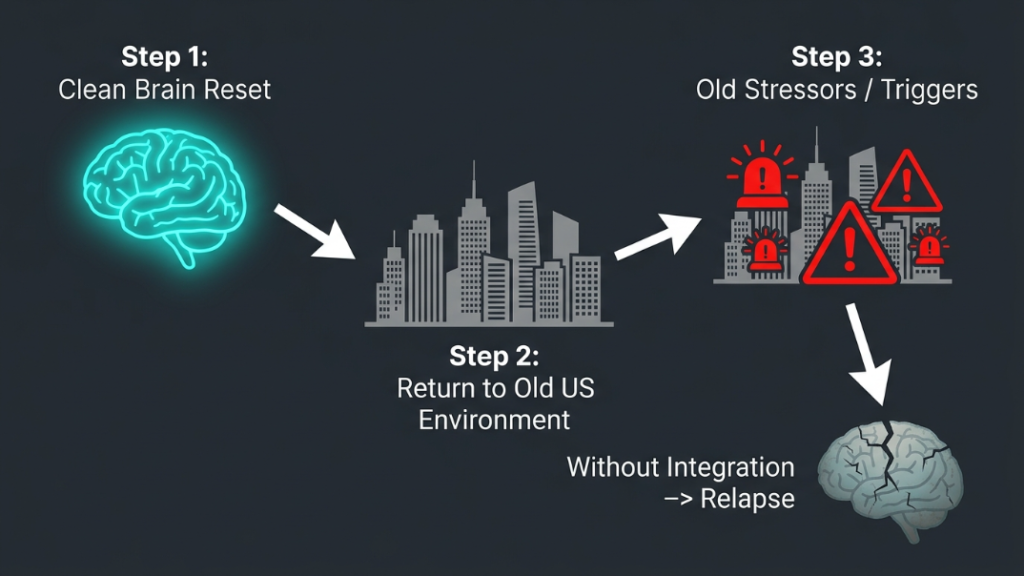
This transition is where many Americans stumble. Because the compound is not integrated into the standard domestic healthcare system, your regular family doctor or local therapist likely knows nothing about it. They do not know how to handle a patient who has just gone through a massive psychoactive reset.
To protect your investment and maintain your sobriety, you have to build your own domestic integration network from scratch.
The medicine can open the door and show you what a clean life looks like, but it will not walk through that door for you. The heavy lifting of long-term recovery takes place in your everyday American life, far away from the beachside clinics.
The landscape of ibogaine therapy usa is undergoing the most significant transformation in its history. The old days of treating this compound purely as an underground secret are coming to an end. With millions of dollars pouring into university-backed research in Texas and California, and federal mandates clearing the path for faster evaluations, we are watching the slow birth of a domestic medical framework.
However, that future is still written on paper inside research labs. For the individual fighting for survival right now, the choice remains a personal journey that requires immense caution, thorough research, and a commitment to the hard work of long-term integration.
If you treat this compound as a shortcut, you will find yourself right back where you started. But if you treat it as a hard-earned second chance—a way to clear the table so you can build a stable, healthy life—it can be the turning point that changes everything.

Traditional recovery programs often feel like a revolving door. You walk into a detox center,
If you live in America and find yourself trapped in the cycle of severe substance

Most conventional addiction treatments feel like dragging a heavy sled through deep mud. You decide