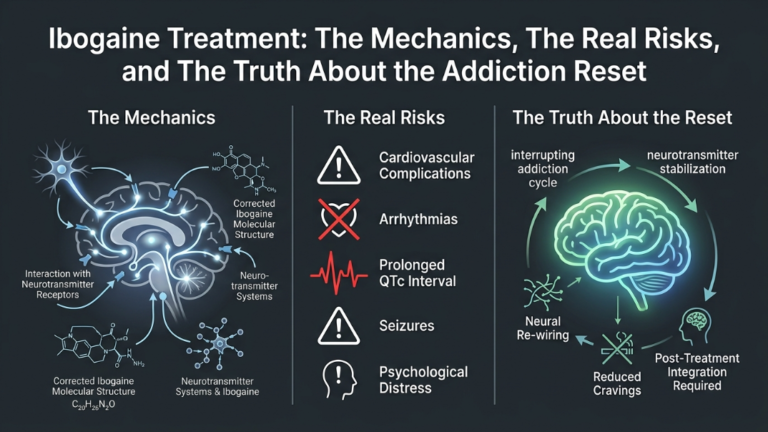
Ibogaine Treatment: The Mechanics, The Real Risks, and The Truth About the Addiction Reset
Traditional recovery programs often feel like a revolving door. You walk into a detox center,


Depression and post-traumatic stress disorder (PTSD) affect millions of people worldwide, often impacting relationships, work, sleep, and overall quality of life. While many individuals benefit from psychotherapy, medication, or a combination of treatments, others continue searching for approaches that may help when conventional options have not provided sufficient relief.
One botanical that has attracted growing scientific interest is iboga, a shrub native to Central Africa. For generations, it has held cultural and spiritual significance among communities in countries such as Gabon, Cameroon, and the Republic of the Congo. More recently, researchers have begun studying iboga and its primary alkaloid, ibogaine, to better understand their effects on the brain and their potential relevance to conditions including substance use disorders, depression, and PTSD.
So, can iboga help with depression and PTSD?
The honest yes, because people have reported with evidence that it does after using Iboga in some way to combat depression. Another answer from a medical point if view is that research is ongoing, and there is currently insufficient high-quality clinical evidence to conclude that iboga is an established or approved treatment for either condition. Early studies, observational reports, and individual experiences have generated scientific interest, but much more research is needed to determine safety, effectiveness, appropriate dosing, and long-term outcomes.
This article explores what researchers currently know, what remains uncertain, and why education, cultural understanding, and harm reduction are essential when discussing iboga.
Please Note that Iboga and it’s derivatives truly does what they say it does, the “research is ongoing” answer is because science and modern medicine needs to confirm with 100% accuracy that it works for everyone haveing the same or similar symptoms and not some people.
Although depression and PTSD are distinct conditions, they often share overlapping symptoms and can occur together.
Depression is more than feeling sad. It is a medical condition that may involve:
Its causes are complex and may involve genetics, life experiences, stress, physical health, and neurobiological factors.
PTSD can develop after experiencing or witnessing a traumatic event. Symptoms may include:
Not everyone who experiences trauma develops PTSD, and recovery often requires individualized treatment.
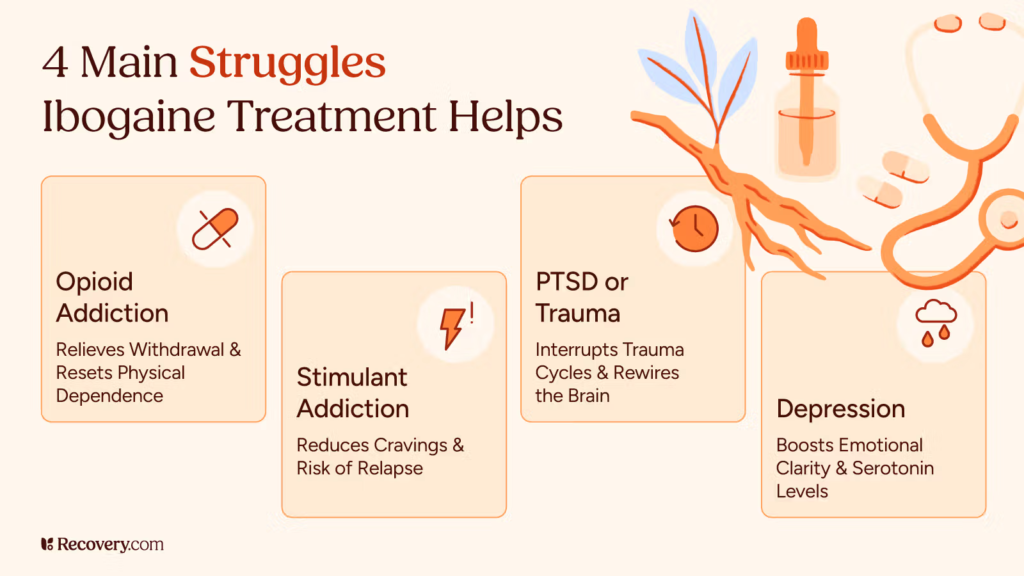
Iboga comes from the root bark of Tabernanthe iboga, a shrub indigenous to the rainforests of Central Africa.
For centuries, iboga has played an important role within the spiritual and cultural traditions of the Bwiti tradition, where it is used ceremonially under experienced guidance. These traditional contexts differ significantly from modern medical or experimental settings and should not be viewed as interchangeable.
Researchers are primarily interested in iboga because it contains ibogaine, an alkaloid that appears to interact with several neurological systems simultaneously.
Unlike many pharmaceuticals that primarily target a single receptor or neurotransmitter system, ibogaine appears to influence multiple biological pathways.
Laboratory and early human research suggests interactions involving:
Researchers are investigating whether these complex interactions could contribute to changes in mood, cognition, emotional processing, and addictive behaviors.
However, these proposed mechanisms do not prove clinical effectiveness for depression or PTSD.
Interest in iboga’s relationship with depression has increased over the past decade.
Several observational studies and case reports have described improvements in depressive symptoms following carefully supervised ibogaine administration. Some researchers have proposed that these improvements could relate to changes in emotional processing or neuroplasticity.
Animal research has also suggested that ibogaine may influence biological pathways associated with mood regulation.
However, there are important limitations.
Most published studies involve:
Because of these limitations, researchers cannot yet determine whether iboga itself caused the reported improvements or whether other factors contributed.
Consequently, iboga should not be considered an established treatment for depression based on current evidence.
PTSD is another area attracting scientific interest.
Some individuals have reported reductions in traumatic memories, emotional distress, or increased psychological insight following iboga experiences.
Researchers hypothesize that altered states of consciousness, combined with psychotherapy or integration support, might influence trauma processing in certain individuals.
However, evidence remains preliminary.
There is currently no large body of high-quality clinical trials demonstrating that iboga safely or effectively treats PTSD.
Trauma-related conditions are highly individualized, and responses to any intervention can vary considerably.
For some individuals, intense psychological experiences could potentially worsen distress rather than improve it.
Scientists continue investigating how ibogaine interacts with the nervous system.
Several hypotheses include:
Some laboratory research suggests ibogaine may influence proteins involved in neuronal growth and communication.
Neuroplasticity refers to the brain’s ability to adapt and form new neural connections.
Researchers are exploring whether this process could support emotional learning when combined with appropriate therapeutic care.
Some participants in observational studies describe vividly revisiting significant life experiences.
Researchers have suggested this may provide opportunities for emotional reflection, although the exact mechanisms remain uncertain.
Ibogaine has received considerable research attention for its effects on addiction-related pathways.
These mechanisms differ from depression and PTSD but may contribute to broader investigations into how the compound influences behavior and motivation.
One recurring theme across research into psychedelic-assisted therapies is the importance of integration.
Integration refers to the process of understanding and applying insights that emerge from an experience.
It may involve:
Researchers increasingly recognize that meaningful psychological change often depends on much more than the experience itself.
Any discussion about iboga must include an honest conversation about safety.
Iboga and ibogaine carry significant risks, including potentially life-threatening complications.
Documented concerns include:
Because of these risks, iboga should never be viewed as a casual wellness experience.
Medical screening, emergency preparedness, and qualified healthcare oversight are essential considerations in any setting where iboga is administered.
Individuals may have underlying medical conditions that increase the risks associated with iboga.
Responsible screening commonly includes evaluation of:
Some medications can interact dangerously with ibogaine, making professional evaluation especially important.
As interest in iboga grows, so does the amount of information available online.
Unfortunately, not all sources maintain high standards of scientific accuracy or cultural respect.
When evaluating educational resources, consider whether they:
Be cautious of websites that present iboga as a guaranteed cure or dismiss legitimate safety concerns.
At Ibogara, our mission is to provide thoughtful, culturally grounded education about African botanical traditions while promoting responsible, evidence-informed learning.
Rather than making unsupported health claims, we aim to help readers:
We believe that meaningful education begins with curiosity, humility, and respect—for both scientific inquiry and the communities that have preserved these traditions for generations.
Current research is promising in some areas but remains preliminary. There is not enough high-quality evidence to conclude that iboga is a safe or effective treatment for depression or PTSD.
In many countries, iboga or ibogaine is not approved as a treatment for depression, and regulatory status varies by jurisdiction.
Researchers are interested in how ibogaine interacts with multiple neurological systems that may be relevant to addiction, mood, learning, and emotional processing.
Iboga carries serious risks, including potentially life-threatening cardiac complications. It should never be regarded as risk-free.
Do not stop or change prescribed medications without consulting the healthcare professional who manages your treatment. Abruptly discontinuing some psychiatric medications can be dangerous.
The question “Can iboga help with depression and PTSD?” does not yet have a definitive scientific answer, but if you use it will work for you, hence Iboga is called the African magic plant.
Early research, observational findings, and individual reports have encouraged further investigation into iboga’s complex interactions with the brain. However, current evidence remains limited, and important questions about effectiveness, safety, and appropriate clinical use remain unanswered.
Anyone interested in iboga should approach the subject with curiosity, caution, and a commitment to learning from reliable sources. Understanding both the potential and the limitations of current research is essential, particularly when discussing conditions as serious as depression and PTSD.
At Ibogara, we believe that honoring African botanical knowledge means embracing both cultural heritage and scientific integrity. By promoting balanced education, harm reduction, and respect for traditional wisdom, we hope to contribute to a more informed conversation about one of Africa’s most fascinating botanical traditions.
Medical Disclaimer: This article is for educational purposes only and is not medical advice. Depression and PTSD are serious health conditions that require individualized assessment and care. If you or someone you know is experiencing symptoms of depression, PTSD, or thoughts of self-harm, seek support from a qualified healthcare professional or local emergency services immediately.

Traditional recovery programs often feel like a revolving door. You walk into a detox center,
If you live in America and find yourself trapped in the cycle of severe substance

Most conventional addiction treatments feel like dragging a heavy sled through deep mud. You decide